
When I was a child I hated taking a bath. I remember, once I had reached a suitable age, being instructed to go take one by myself and then just letting the tap run for a bit and sitting stubbornly on the top stair, just out of eyeshot of the living room.
I’m not sure what my direct aversion to taking a bath was caused by, possibly the real fear of stinging soap being flushed into my eye, or the connotations of ‘work’ that the word ‘cleaning’ brought. Cleaning was not for pleasure, it was a chore. Helping to clean the dishes or the car was time taken away from whatever else my ten-year-old self wanted to do. When I went to the pool, stripping off and washing before putting my swimsuit on was an necessary inconvenience before I could have fun. Likewise showering after sports, or before lectures or work was something I did as a matter of fact because (as I found out becoming a teenager) it was much preferred to the alternative. It wasn’t until I moved to Japan that I began to see bathing as a genuine leisure pursuit.
Despite my early aversion to taking a bath, I’ve always loved water, as a child I swam often, I earned my PADI Advanced Open water before my driver’s licence. Nothing captures my imagination more than the thought of water, and what it might contain, and what can be done with it. If I was a creature born millennia ago, I would be one of the first to abandon hope for the land and crawl back into the sea to eventually become a whale or dolphin.
All of Japan is famously volcanic, and a byproduct of this activity is the numerous onsen springs that lie across the country. Every prefecture in Japan has some access to these natural bathing sites, and over the centuries theses places became the social hubs of everyday Japanese society. Before the country’s introduction to the west these sites were largely mixed. Men, women and children would bathe together. Over time however they have become mostly gender separated, although a small number of mixed sites do remain. They are a safe space, where the worries out the world are left outside in your locker, with your clothes. Onsen have been an integral part of Japan for thousands of years. They existed as meeting spaces, a social necessity, a place to meet people and discuss, and most importantly get clean. Cleanliness being more than a virtue in Japan.
I was lucky enough to be placed by my employer in Fukuoka prefecture, only a forty-five minute train from Beppu, in Oita prefecture, one of the countries best onsen resorts. Kyushu island is covered in onsen hot spots. But even if an area doesn’t have access to a natural spring, pubic bathhouses (sento) are equally popular. A week after arrival, before I’d even finished packing or buy furniture, I was stepping my freshly washed naked body into the hot waters of the local sento. These spaces have fascinated me since first I heard about them. My only similar experience being the hot springs of Budapest that I had visited as a student. This was something new however. In Budapest there was a heavy focus on moving between hot and cold rooms, sitting in excruciating heat and jumping into icy pools. There is some of that here. But in Japan there is a focus on getting clean and simply enjoying the hot pool. Everything else is optional.
There is a specific procedure when using onsen, mainly all scrubbing, soaping and rinsing is to be done outside the bath before getting in. No clothes can be worn inside the onsen. You may carry a small hand towel, but even this isn’t allowed into the water. After removing my shoes and placing them in the small coin lock (squeezing both of my UK 12s into the small narrow box) I paid my entrance fee at the little machine at the door. I also bought myself a small towel, used for washing at the sit-down washing stations, and for covering yourself vital bits as you move between baths.
I was asked by an attendant if I knew how to take a Japanese bath, of course I did, I had studied the online tutorials, I knew the process was three step; undress completely, wash throughly, bathe indefinitely. I grabbed my small towel, and hobbled through the steam into the next room.
It was busy, far busier than I had expected, I was the only foreigner there, which I find is almost always the case. I took a seat at the washing station. You’re provided with a shower head and a bowl to wash with, and a small plastic stool to sit on. I still find these uncomfortable, they’re not designed for tall gaijins such as myself, but I loaded up soap my small towel, and began scrubbing.
It didn’t take long for me to realise that this was much a part of the onsen experience as the bath itself. The process of giving yourself a very good scrub with a basin of hot water and a shower head was something I sorely missed as the small home I had inherited from my predecessor at my job in Japan was old, the hot water retrofitted into the building, and the bathroom, a wet room with a bath so small you had to crouch in it, was unpleasant to use at the best of times and horrific in the winter. In the summer the water came out lukewarm, and if it was heated was scolding even at the lowest setting. It was easy to see how the bathhouse has remained socially relevant right up until the present age. It just feels better, time devoted to cleaning yourself and relaxing. Once I was finished I washed down my station and trotted over to the nearest bath, it was already occupied by three other men, all of whom seemed indifferent to my presence. I put my foot in, it was hot, maybe a little too hot. I moved my towel away from my groin and onto my shoulders and slunk in. The bath was warming and absolute, the weight of it putting gentle pressure on my stomach as I sat further down. I moved my towel again and submerged myself up to my neck. I breathed, hot steam filling my lungs. The three men chatted away as I closed my eyes.
Eventually I moved from the hot pool, outside into the air. The day was still hot, and probably humid, but I couldn’t tell anymore. There was a small TV on the wall that some men were watching quietly, it played local news. I tried a few more baths, some temperate ones outside. Another man attempted to make casual conversation with me, my Japanese skills at the time were somewhat lacking, I only nodded and smiled as he talked. He eventually gave up, and feeling embarrassed at my foreignness I left the pool. Outside there were some shallow baths, for lying horizontal in, as well as large wooden tubs with taps constantly filling them, the idea being to submerge yourself entirely and sit under the running water. However, both were occupied. I tried the sauna, which was punishingly hot, but there was also a TV inside, sitting behind thick glass and displaying one of the numerous Japanese talk shows that seem to play on a loop all day. There were Jacuzzi tubs too, that had variable settings, and similar wave tubs that seemed to simulate a whirlpool where you are supposed to sit. The steam room however I found to be the best, it was the right temperature and had a bowl of salt in the centre that would leave your skin feeling great afterwards, just be careful not to get any in your eyes.
In the steam room another man spoke English to me there, I got the usual question, the assumption that I was American. I corrected him gently. He asked if It was my first time here, I said yes, He mentioned how many foreigners are shy of being nude, I agreed hesitantly. He asked if we had hot springs like this in the United Kingdom, I replied that we didn’t, and that it was a shame. He laughed at that.
The best onsen are often in enjoyed most in the remotest parts of Japan, the places where they have built havens from the world outside, where we can soak and discuss whatever issues we desire. It’s simply time to be alone, without weight or agenda, physical absent from the world whilst our minds remain a part of it. Half submerged. Some of the best moments I’ve had in Japan are soaking halfway up a mountain admiring the autumn foliage, in Beppu’s mountain springs, or relaxing with friends watching the night view over Nagasaki on a night so clear it is impossible to tell when the city lights stop and the night sky begins. Emerging from a good onsen feels like shedding your skin. You feel great for days. There is much to be said about a hot bath where you can stretch your legs, get up and walk about in the fresh air and return at your leisure. It’s something that can’t be replicated at home. It turns from what could be a boring necessity about daily life, into something much more beneficial. Even the simplest of urban sento offer a sense of community, along with the chance to get a really good scrub.

 That early morning pilgrimage to Tokyo’s ‘secret’ breakfast spot has become something like folklore for visitors to the nation’s capital. I approached the market myself in December, excited and hungry for a chance to sample ‘the best sushi in Japan’. However, I found the throngs of people, simply distracted from the often mentioned ‘otherworldliness’ of the place, and more importantly, they got between me and the sushi.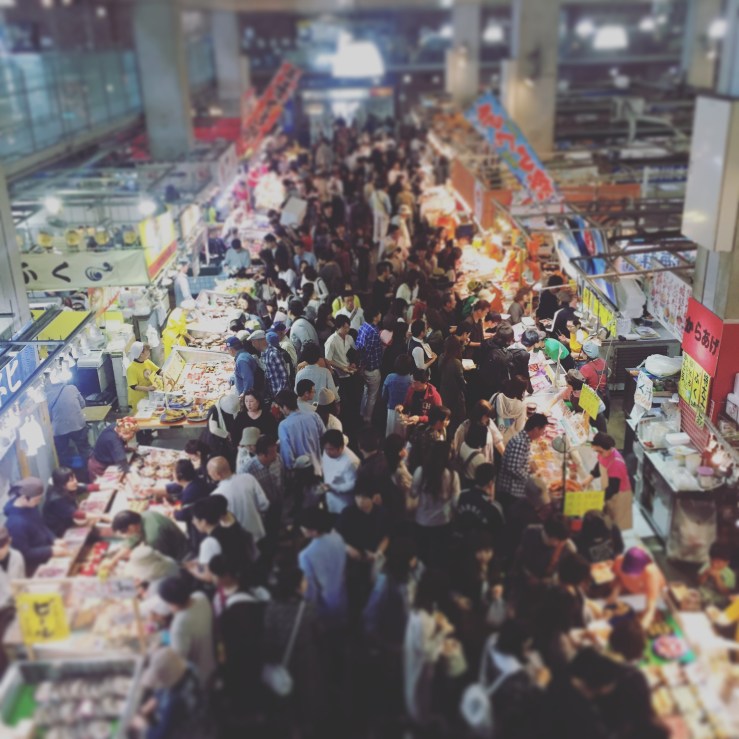
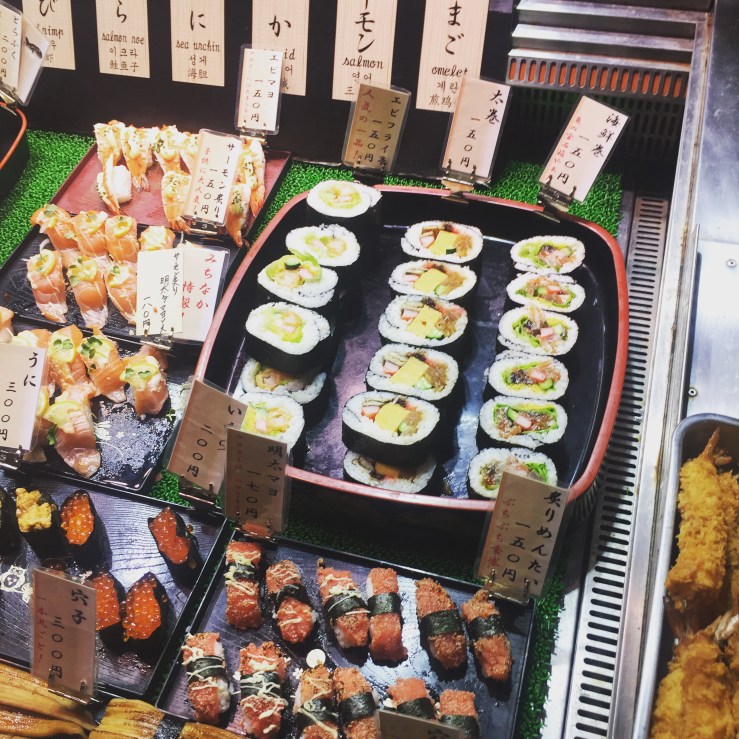
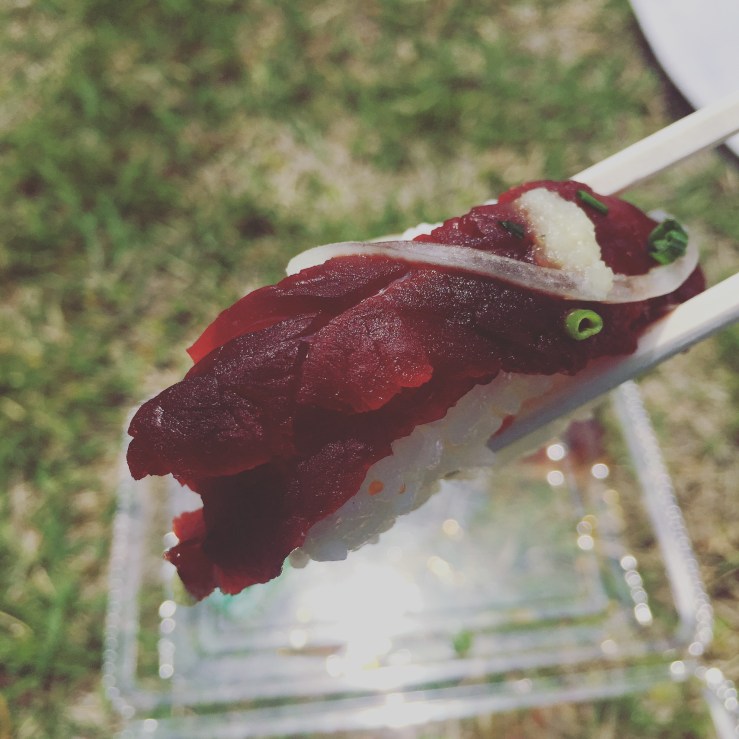 The market exists as a ‘hidden gem’ in much the same way Tsukiji once did. The building is somewhat unassuming, and on the days I have visited most of the crowds seemed to be heading to the nearby aquarium or children’s park. But inside the unassuming building is an open nest of busy stalls, selling fresh sushi for as little as 100 Yen, and of a much higher quality that your typical ‘kaiten’ sushi joint too. Karato offers a startling array of choice, including whale meat and the local speciality Fugu, the infamous dish which is famous for poison if not prepared correctly. Here the fugu is sold in sets, pre-cut and displayed fan-like on plates which are kept refrigerated somewhere out of sight. Plastic mock-ups of your fugu dinner are displayed out front, you simply need to point to order. Unlike the other fish on sale there are no ‘do-it-yourself’ kits for fugu here, and probably sensibly so. The area remains where the majority of Japan’s fugu harvest is caught and processed, and the city of Shimonoseki is a little mad for the stuff, you’ll find fugu designs everywhere in the city, and plastered on everything in the gift shops. Even the fabric on the bus seats have a fufgu design.
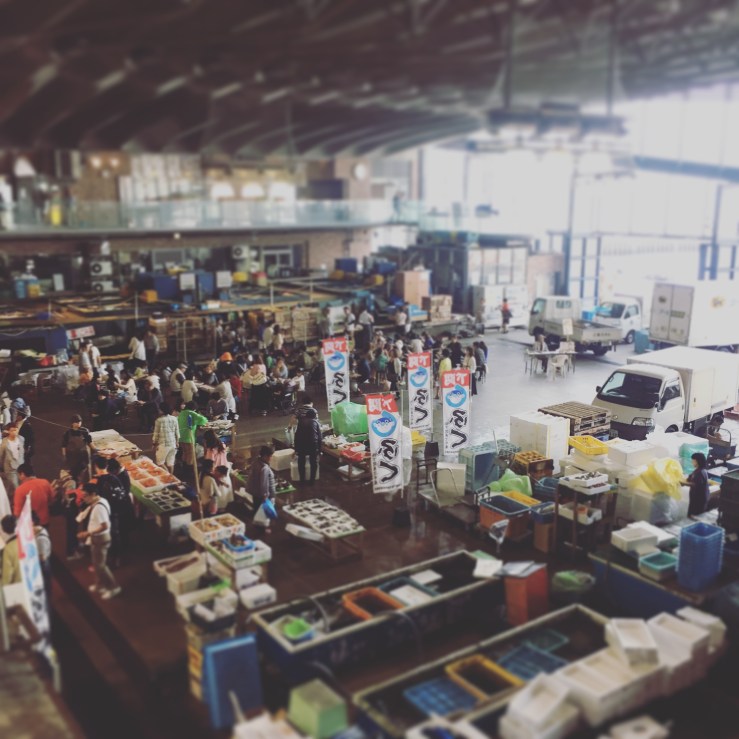 Shimonoseki is the freshest place to try it, many restaurants will serve it as a set meal. It’s not cheap however, often prices start from at least 5000 Yen, it’s a delicacy, perfectly safe when prepared by a professional. I found the taste is light and delicious, like a lot of Japanese food the flavours a subtle. It’s almost always served thinly sliced, translucent looking on the plate, often with soy, onion and wasabi as seasonings. The skin can also be served shredded; it has a texture like jelly.
 The World is Quiet